
The Must-Win Battles Framework: How to Build a JBP Your Retail Partner Will Actually Prioritize


Share
Summarize with AI
I've reviewed a lot of joint business plans over the years. The ones that fail rarely fail because the thinking was bad. They fail because everything was a priority, which means, in practice, that nothing was.
A strong joint business plan is not a long list of activities. It's a focused plan built around three must-win battles: the priorities that move the retailer's own number, protect the relationship, and sit where the supplier has a genuine right to win.
If everything in your JBP is a priority, nothing is. The strongest suppliers I've worked with in the UAE and Saudi Arabia don't bring their retail partner twelve initiatives. They bring three. That holds across the GCC, where a supplier's growth usually depends on a handful of retailer relationships rather than dozens.
- The Must-Win Battles framework focuses a JBP on 3 priorities instead of ten, adapted from Peter Killing, Thomas Malnight, and Tracey Keys' 2005 strategy book.
- The Strategy House gives it structure: a roof (the shared growth goal), pillars (the 3 must-win battles), and a foundation (trust, data transparency, follow-through).
- Three questions filter a long list down to real must-win battles: does it move the retailer's own number, does ignoring it risk the relationship, and do you have a genuine right to win.
- The battles worth fighting usually map to a competency your retailer already scores you on, which is what makes them easy for a buyer to sponsor internally.
- A must-win battle without an owner and a KPI is a slogan, not a plan.
Why Most JBPs Try to Do Too Much
A JBP with ten objectives reads like a wish list, not a plan. Retail buyers are managing dozens of supplier relationships at once, so a plan that asks for focus on everything gets focus on nothing. As we covered in our guide to JBP basics, the plans that actually change how the year goes are the ones built on a real, working relationship, and a relationship can't carry ten priorities. It can carry three.
The Must-Win Battles Framework, Explained
"Must-Win Battles" isn't an ADVSELL invention. It's a strategy framework first laid out by Peter Killing, Thomas Malnight, and Tracey Keys in their 2005 book Must-Win Battles: Creating the Focus You Need to Achieve Your Key Business Goals. The core idea: every organization has limited resources, so trying to win on every front guarantees winning on none. Instead, leadership identifies the 3 to 5 critical challenges that will genuinely determine the company's future, and puts the best resources behind those alone.
What I've found working with FMCG suppliers across the GCC is that the same logic applies at the level of a single retailer relationship. You don't need a must-win-battles process for your whole company to use one for your JBP.
The Strategy House: Putting Structure Around the Battles
The Strategy House is a companion framework, widely used by firms including McKinsey, BCG, and Bain, that gives must-win battles a visual structure: a roof (the shared goal), pillars (the 3 to 5 must-win battles supporting it), and a foundation (the values or conditions the whole thing rests on). Some versions add a separate "enablers" layer of capabilities between the pillars and the foundation. For a JBP, that layer isn't separate. It folds into the foundation itself: the systems and habits (shared dashboards, regular joint reviews) that make trust and data-sharing actually work day to day, not just on paper.
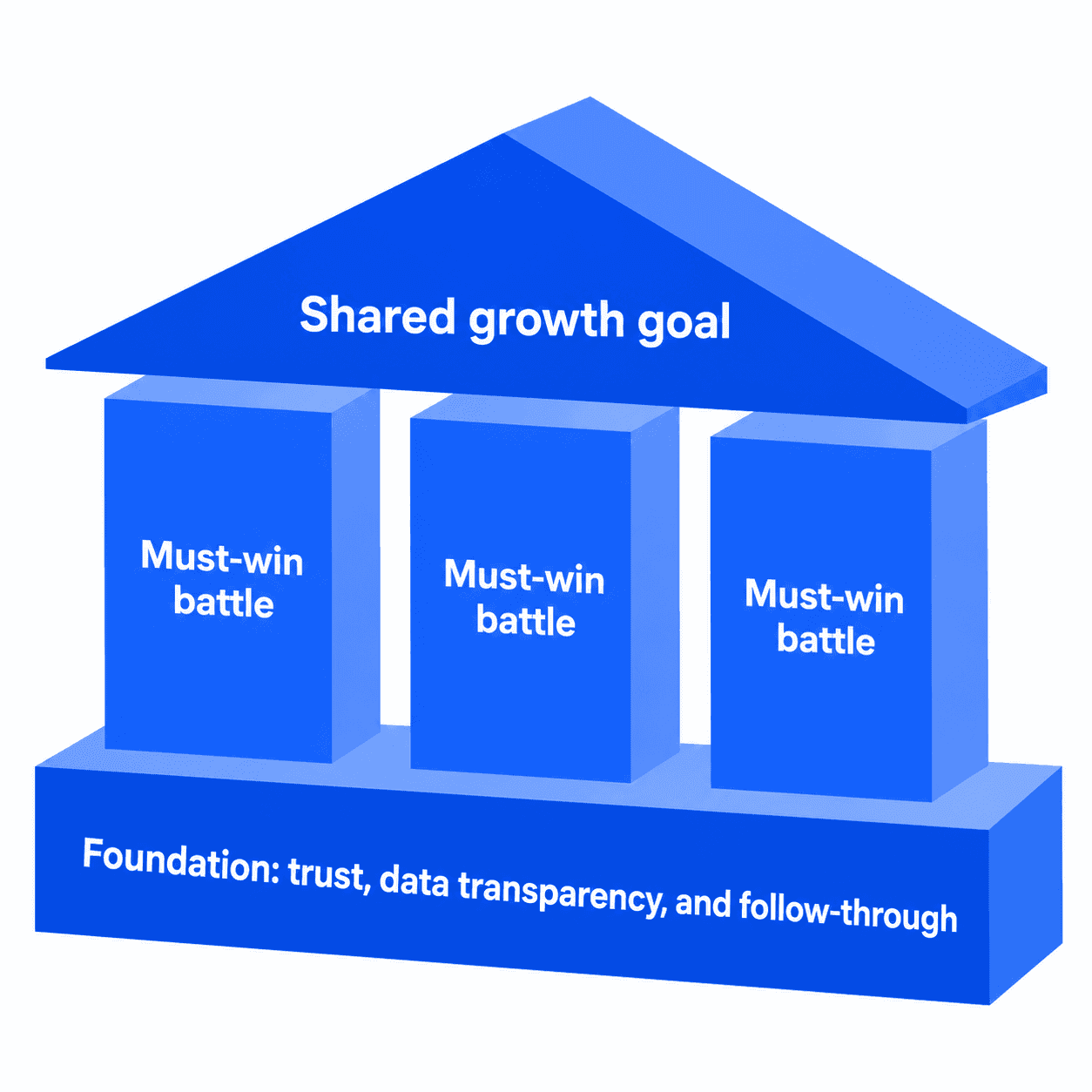
Applied to a JBP, it looks like this:
- The roof: the shared growth goal both you and your retail partner are actually trying to hit this year, stated as a number rather than an ambition: category sales growth, market share, or revenue against a named baseline.
- The pillars: your 3 must-win battles. Not ten initiatives. Three.
- The foundation: trust, data transparency, and follow-through. This is the same ground we cover in the JBP guide: the plan only holds up if the relationship underneath it does.
A Strategy House is only worth building if it stays current. Rebuild it when the shared goal moves, not once at the annual reset, or it quietly becomes a slide nobody opens.
How to Pick Your 3 Must-Win Battles for a JBP
This is where the general framework needs a specific answer for supplier-retailer planning. Three questions narrow a long list down to the battles that matter:
- Which initiative, if it succeeded, would move the number your retail partner actually cares about? Usually category sales growth, market share, or basket size. Their number, not your internal KPI.
- Which gap, if left unaddressed, would quietly cost you the relationship over the next 12 months? This is usually the uncomfortable one to name.
- Where do you have a genuine right to win? Not everything worth doing is something you're positioned to do better than anyone else at that shelf.
Underneath all three questions is a simple return-on-investment test: a must-win battle should justify itself in trade dollars spent versus trade dollars returned, not just strategic appeal. Anything that doesn't clear a "yes" on one of these three isn't a must-win battle. It might still be worth doing, just not in this JBP. A useful secondary check comes from the original framework itself: a genuine must-win battle makes a real difference, is market-focused, creates real engagement across both teams, is specific and concrete, and is actually achievable with the resources on hand.
There's a practical shortcut here that most suppliers miss. The battles worth fighting almost always sit inside one of the competency areas retailers are already scoring their suppliers on: Organisation & People, Trade & Shopper Marketing, Supply Chain & Customer Service, Category & Consumer Marketing, and E-commerce. That's the structure behind the Advantage Report, and it's a useful filter, because a battle that doesn't map to something your retailer already measures is a battle you'll be fighting alone. An on-shelf-availability gap sits in Supply Chain & Customer Service. An assortment optimization project sits in Category & Consumer Marketing. Naming the competency makes a battle far easier for a buyer to sponsor internally, because it maps onto how they're already being measured too.
Once a battle clears both filters, it still needs to be broken down before it goes into the plan: why it matters, what success actually looks like, how it will be won, who owns it on each side, and the milestones and KPIs that will show whether it's on track. A must-win battle without an owner and a KPI is a slogan, not a plan.
The original framework allows for 3 to 5 pillars. For a single retailer relationship, I push toward the tight end of that range on purpose: a JBP has one buyer's attention and a finite trade budget behind it. Three is the number a buyer can actually track and resource without the plan sliding back into the ten-initiative wish list this framework exists to prevent.
One more thing the original framework gets right that's easy to skip under deadline pressure: must-win battles are a living document, not a one-time workshop output. Revisit them on a quarterly cadence alongside the Execute & Monitor stage, not just at the annual reset. The most common mistake I see is teams treating the three battles as fixed for twelve months while the category moves underneath them. Teams already running OKRs or a balanced scorecard internally don't need to abandon those. A JBP's must-win battles sit a level below: the specific 3 priorities that particular OKR or scorecard translates into for this one retailer relationship.
What This Looks Like in Practice
The following is an illustrative scenario, not a specific client case.
Picture a mid-sized FMCG supplier going into a JBP renewal with a major UAE grocery retailer. Their instinct is to bring a long list: new SKU listings, a promotional calendar, a supply chain fix, a digital shelf project, a sustainability commitment. Applying the framework, three genuinely clear must-win battles emerge: fixing a recurring on-shelf-availability gap that's costing both sides sales, aligning on a category growth plan for one underperforming segment, and building a joint forecasting process to reduce the lead-time mismatch between the two teams. Everything else moves to next year's plan.
The retailer, instead of reviewing twelve initiatives at year-end, has three clear things to say yes or no to, and the supplier has three things they can actually resource properly.
Frequently Asked Questions
What are must-win battles in business strategy?
Must-win battles are the 3 to 5 critical challenges an organization identifies as genuinely determining its future, so that resources concentrate there instead of spreading across every possible initiative. The framework was introduced by Peter Killing, Thomas Malnight, and Tracey Keys in their 2005 book Must-Win Battles.
What is the Strategy House framework?
A visual strategy framework built from three parts: a roof (mission or shared goal), pillars (3-5 strategic themes or must-win battles), and a foundation (corporate values or underlying conditions). It's used by major consulting firms including McKinsey, BCG, and Bain to make strategy easier to communicate, align on, and execute across an organization.
How many must-win battles should a JBP have?
Three is the number we recommend for a single retailer relationship. Fewer than three and the plan may lack ambition; more than three and neither side can resource them properly.
How do you know a must-win battle is the right one?
It moves a number your retail partner is already accountable for, it maps to a competency they measure suppliers on, it has a named owner on both sides, and it has a KPI you could both check mid-year. If any of those four is missing, it's an initiative, not a battle.
How is this different from a normal JBP priority list?
A priority list ranks everything. Must-win battles deliberately exclude most things, so the few that remain get real resourcing and real follow-through, which is what the data on JBP performance shows actually drives results.
Most JBPs fail from trying to do too much, not too little. The Must-Win Battles framework works because it forces a hard choice: three priorities a retailer can actually track and resource, backed by real ownership and KPIs, beats ten initiatives that dilute into nothing.