
What Is Assortment Optimization? A Guide for Retailers and FMCG Suppliers


Share
Summarize with AI
Every retailer carries products that quietly cost them money, and drops products that were quietly making it. Assortment optimization is the discipline that tells the difference.
- Assortment optimization is the continuous, data-driven process of deciding which products a store or category carries, not a one-time range review.
- Effective programs consistently cut markdowns, lift sales, and reduce excess inventory versus an unfocused range, with Bain's own research showing double-digit revenue growth even after significant SKU cuts.
- The discipline is as much about removing products that don't earn their shelf space as adding new ones.
- It runs through five stages: Data Collection, Performance Evaluation, Define Optimal Assortment, Gap Analysis, Implement & Review.
- It's usually one of the concrete initiatives inside a joint business plan, backed by data rather than opinion.
What Assortment Optimization Actually Is
Assortment optimization is the data-driven process of selecting and continuously adjusting the mix of products a store or category carries, to balance customer choice, shelf space, and profitability. It's a decision made per store and per category, not once for an entire chain: a hypermarket in one city and a smaller-format store in another can carry meaningfully different assortments of the same category, and both be right, because their shoppers, space, customer preferences, and local demand aren't the same.
This is different from a one-time range review. Done properly, assortment optimization is continuous: the mix gets re-tested against fresh sales and demand data on an ongoing cycle, not fixed once a year and left alone.
It also starts from a specific customer-centric idea: most shoppers aren't loyal to one exact product. They're looking for a bundle of attributes (a certain size, price point, or flavor profile) that several SKUs could satisfy. In practice, the retailer is modeling how customers choose among available items, not assuming every SKU matters equally. Assortment optimization is the discipline of figuring out which specific products actually deliver that bundle for a given store, not assuming every SKU in a range is equally irreplaceable.
Why It's Worth Getting Right
The upside is well documented and larger than most retailers assume. A disciplined assortment review typically pays off through fewer markdowns, higher sales, stronger customer satisfaction, and better operational efficiency, since a tighter, better-chosen range is more likely to meet customer demand and sell through more predictably than a long, unfocused one. Bain's own research found a food category in Belgium grew revenue 17% despite a 42% SKU cut, and a candy category in Sweden grew sales 19% while selling 18% fewer items. McKinsey's retail analytics work points to 2–4% gross margin gains specifically from eliminating "value-destroying" variants: SKUs that exist on the shelf but actively erode margin once cannibalization and carrying cost are accounted for.
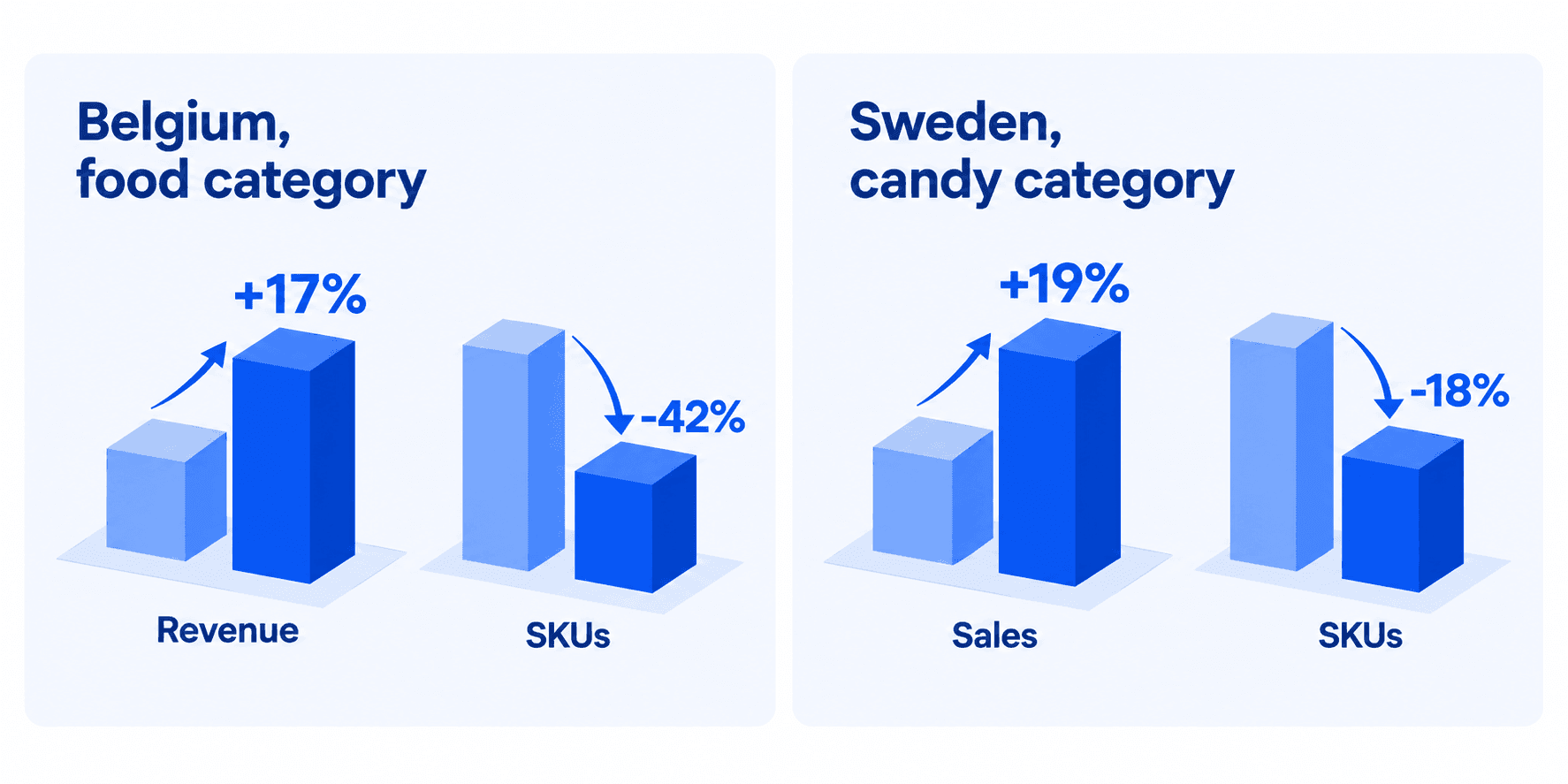
The pattern across all three: assortment optimization isn't primarily about adding products. It's about having the discipline to remove the ones that don't earn their shelf space, and back the ones that do.
The Assortment Optimization Process, Step by Step
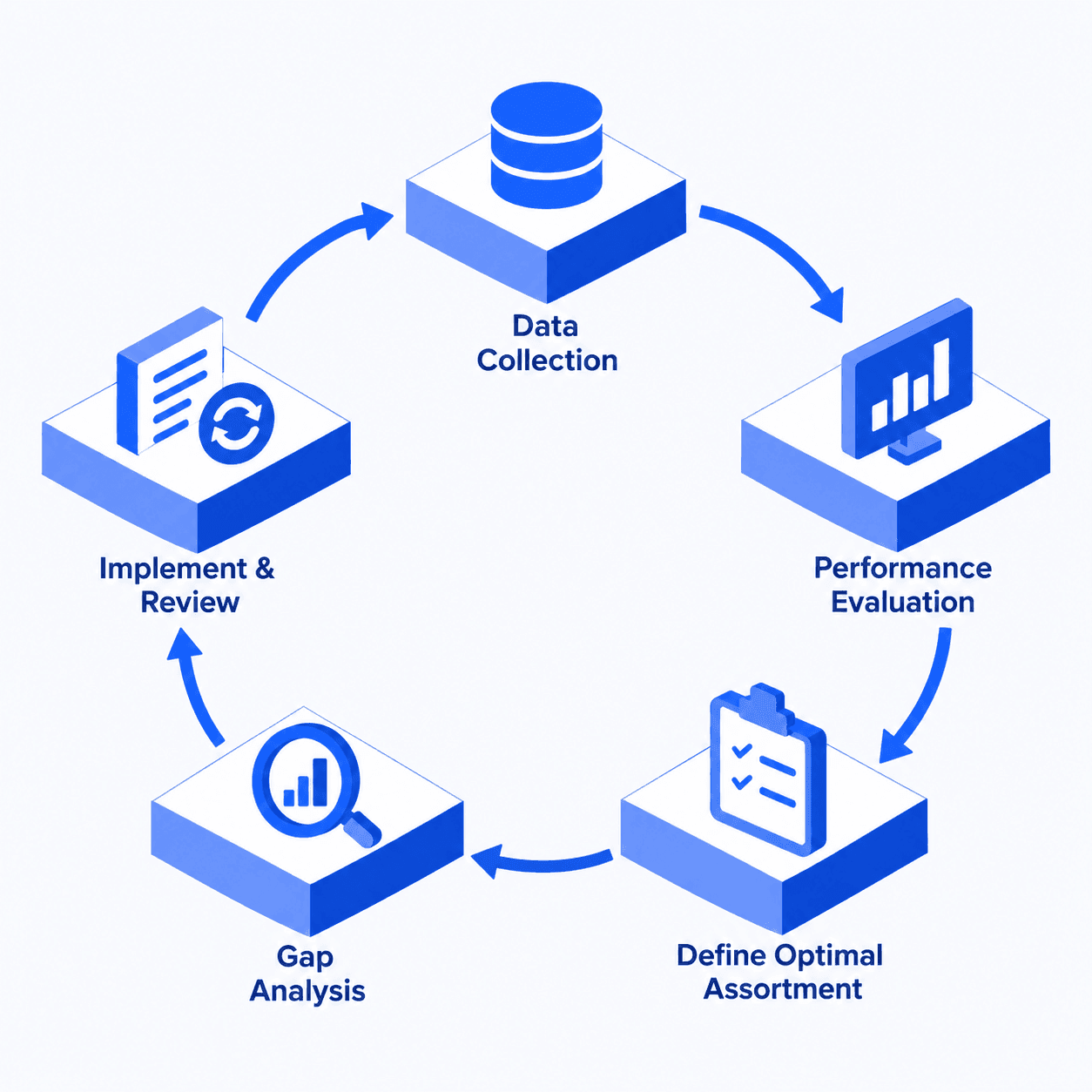
- Data Collection & Analysis: sales history, local demand signals, and consumer trends get pulled together at the category and store level, not just chain-wide, helping teams spot market trends and make more informed, data-driven decisions.
- Performance Evaluation: an ABC-style analysis ranks products by their actual contribution, commonly showing that a "C" tier of low-performing SKUs contributes as little as 5% of category revenue while still occupying real shelf space.
- Defining the Optimal Assortment: using that data, a target mix gets modeled for each store or cluster of stores, based on demand, space, and category strategy, not last year's range carried forward by default.
- Gap Analysis: the current assortment gets compared directly against that optimal mix, and the specific differences (what to add, what to cut, what to resize) get named.
- Implementation & Review: changes go live, and results get measured against the baseline, increasingly through real-time shelf-monitoring tools like Vispera rather than a periodic manual check, feeding straight back into the next Data Collection stage rather than waiting for a fixed annual review.
The full step-by-step process guide breaks each stage down in detail, including the ABC analysis and store-clustering mechanics. The AI and machine-learning layer is what's compressing steps 1 to 3 from a quarterly exercise into a continuous one.
Where This Fits Into a Broader Retail Strategy
Assortment optimization rarely sits in isolation. It's typically one of the concrete initiatives that comes out of a joint business plan between a supplier and retailer: a specific, measurable must-win battle a supplier can bring to the table, backed by data rather than opinion. It also connects directly to space planning and supply chain execution: an assortment decision that isn't backed by available shelf space or reliable replenishment doesn't actually work on the floor, no matter how good the data behind it looks, especially as assortments increasingly span multiple sales channels, from physical stores to online platforms. In the Advantage Report methodology, assortment decisions sit inside the Category & Consumer Marketing competency area, alongside objective category insights and product innovation, and get benchmarked the same way relationship quality does elsewhere in the plan.
Frequently Asked Questions
What is assortment optimization?
The data-driven process of selecting and continuously adjusting the mix of products a store or category carries, to balance customer choice, shelf space, and profitability, on an ongoing cycle rather than a one-time review.
How is assortment optimization different from category management?
Category management is the broader discipline of managing a product category as a business unit (pricing, promotion, placement, range). Assortment optimization is one part of that: specifically, deciding which products belong in the range and in what depth.
What data do you need to run assortment optimization?
At minimum: store or category-level sales history, current on-shelf range, available space, and some view of local demand or customer demographics. More mature programs add basket data, substitution/cannibalization analysis, and demand forecasting, often built on a choice model that estimates how customers trade off between available items rather than treating each SKU's sales in isolation.
How often should an assortment be reviewed?
The strongest programs treat it as continuous, not annual, reviewing performance data regularly enough to catch a declining SKU or an emerging gap well before the next full range reset.
What's the most common assortment optimization mistake?
Adding new products without removing underperforming ones. Range growth without discipline on the bottom end is the single most common reason assortment optimization programs fail to show a margin improvement despite real effort.
Assortment optimization isn't a seasonal reset. It's a continuous discipline that treats every SKU's shelf space as something that has to be earned and re-earned. Retailers that run it well don't just add products, they have the discipline to remove the ones that don't perform.