
How AI and Machine Learning Change Assortment Optimization


Share
Summarize with AI
Assortment optimization has always run on the same six-step process. What's changed in the last few years is how fast those steps run, and how much of the analysis a human still has to do by hand.
- Machine learning doesn't replace the six-step assortment process, it compresses steps 1 through 4 from a quarterly cycle to something closer to daily or weekly.
- The main ML applications are demand forecasting, customer segmentation by actual buying behavior, price elasticity modeling, and computer-vision shelf monitoring.
- The retail technology market for this kind of assortment and space optimization software is growing fast, as more retailers replace spreadsheet-based analysis with dedicated platforms.
- ML models can flag a slow-moving SKU and recommend a markdown before it becomes dead stock, instead of waiting for the next scheduled review.
- It doesn't replace the category manager's judgment or the trust behind the retailer relationship, it only models the numbers.
Why Retailers Are Adding Machine Learning Here
The shift isn't novelty. It's that Steps 1 through 4 of the manual process (data collection, ABC analysis, store clustering, modeling the optimal assortment) are exactly the kind of pattern-recognition-heavy, data-intensive work machine learning is well-suited to compress. Platforms like Hypertrade are built specifically to turn that raw retail data into store-level recommendations rather than a static report.
Where ML Actually Fits in the Process
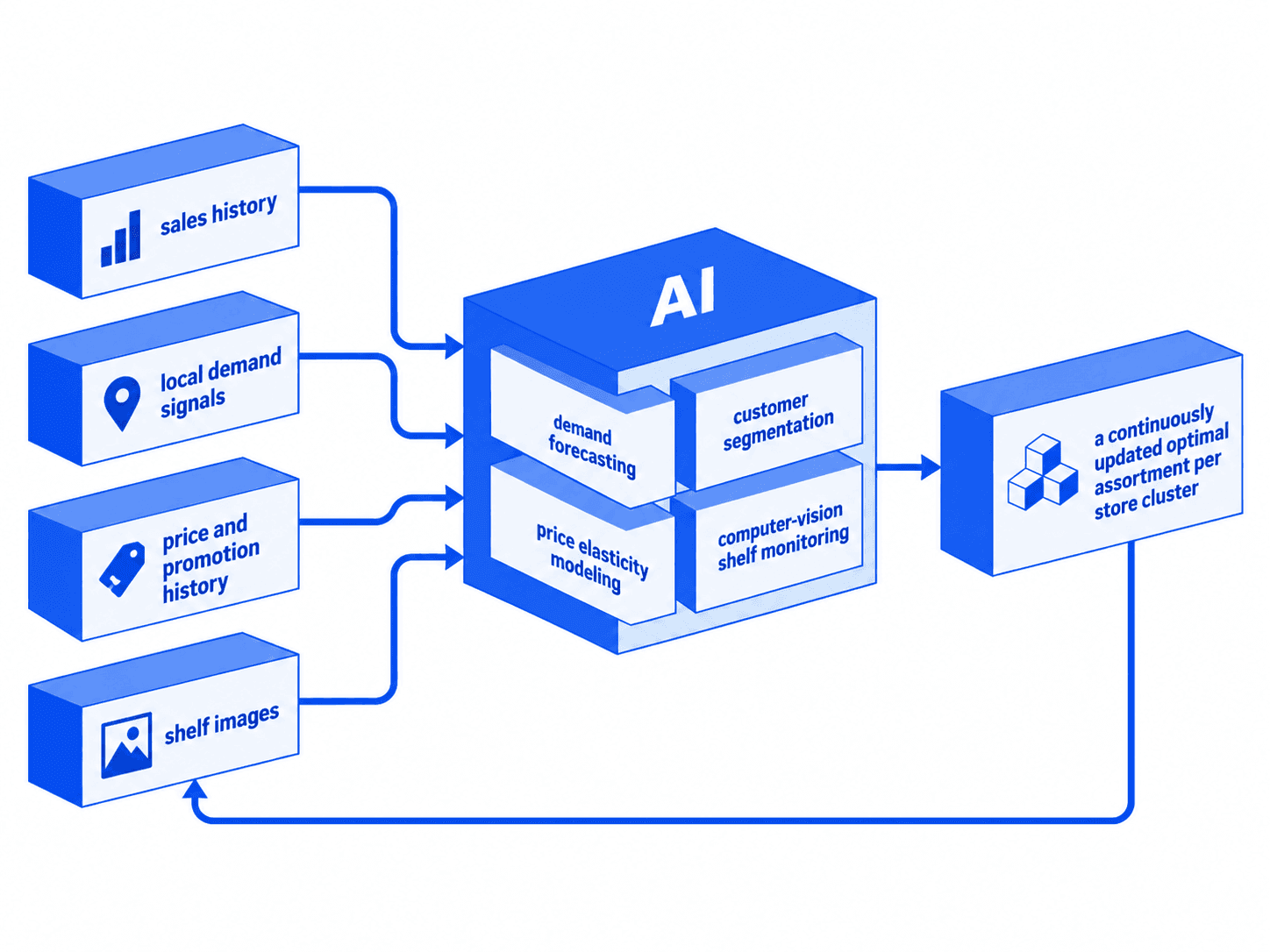
Demand forecasting. Instead of projecting sales from a simple historical average, ML models (regression, time series analysis, and increasingly deep learning) incorporate external signals like seasonality, local events, and economic indicators to forecast demand per SKU per store with meaningfully better accuracy than manual methods.
Customer segmentation. Rather than clustering stores purely on demographics and footfall (the manual method from Step 3 of the process article), ML segmentation models group customers by actual buying behavior and preference patterns, letting the assortment get tailored to how people in a given cluster actually shop, not just where they live.
Price elasticity modeling. ML models can estimate how strongly a price or promotion change will move demand for a specific SKU, which feeds directly into markdown and promotional assortment decisions, an input the manual ABC/cluster process doesn't naturally account for. In practice, this is what lets a model flag a slow-moving SKU early and recommend a markdown before it turns into dead stock, instead of waiting for the next scheduled ABC review to catch it.
Real-time shelf monitoring. The fourth application is the one that closes the loop. Image recognition and computer vision tools like Vispera read the physical shelf directly, turning photos into structured data on what's actually facing the shopper: on-shelf availability, share of shelf, planogram compliance, and pricing accuracy. This matters because every model above assumes the planned assortment is the one on the shelf. It frequently isn't, and without real-time data on that gap, a demand forecast can be perfectly accurate about a product that simply isn't there to buy.
What This Changes in Practice
The biggest practical shift is cadence. The manual process runs Steps 1-4 on a quarterly cycle because pulling and reconciling the data by hand takes that long. An ML-driven version of the same steps can re-score every SKU's performance and flag emerging gaps continuously, closer to daily or weekly than quarterly. That means the gap between "a product started underperforming" and "someone notices" shrinks from months to days.
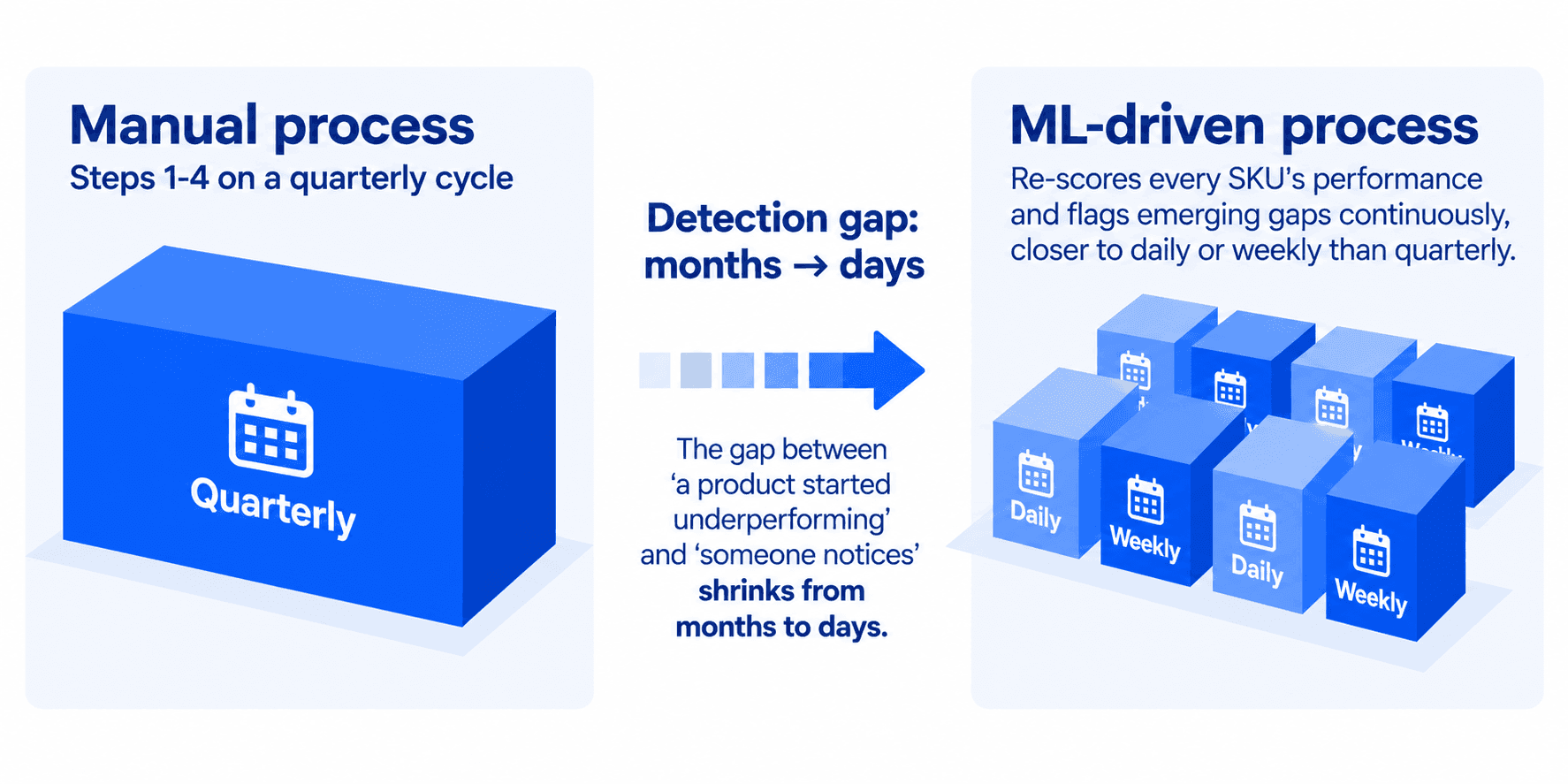
It doesn't shorten Steps 5 and 6 (running the listing/delisting cycle, implementing changes, and measuring results) nearly as much, because those still involve physical range changes, supplier negotiation, and enough time for new sales data to accumulate before you can trust a read on performance.
What It Doesn't Replace
Machine learning models the numbers. It doesn't negotiate the joint business plan initiative that gets a new SKU listed, doesn't understand why a retailer might keep a low-margin product for strategic reasons a model can't see, and doesn't build the trust that determines whether a supplier's data gets shared honestly in the first place. The category manager's judgment, and the strength of the underlying retailer relationship, still decide what actually happens with the model's output.
That last point is easy to underrate. A model's recommendation only becomes a range change if a retailer acts on it, and retailers act on recommendations from suppliers they rate highly. A supplier with a sophisticated model and a weak relationship score tends to find its recommendations politely received and quietly ignored, which is a people problem rather than a data-science one.
Frequently Asked Questions
Do you need machine learning to do assortment optimization?
No. The manual process (ABC analysis, store clustering, structured review) works and is where most retailers start. ML speeds up and refines the same process; it doesn't replace the need to run it.
What data does ML-based assortment optimization need?
The same foundation as the manual process (sales history, space data, local demand signals), plus enough historical volume and consistency for a model to learn reliable patterns. Sparse or highly inconsistent data limits how much ML actually adds.
Can small retailers use ML for assortment decisions?
Increasingly yes, through retail analytics platforms that package these models rather than requiring an in-house data science team. The main constraint is usually data quality and volume, not access to the technology itself.
What's the difference between AI and traditional assortment analytics?
Traditional analytics (like ABC analysis) applies fixed rules to historical data. AI/ML models learn patterns from the data itself and adapt as new data comes in, which is why they handle demand forecasting and price elasticity better than static rule-based methods.
Machine learning changes the speed of assortment optimization, not its substance. The retailers getting real value from it are the ones already running the manual process well. ML makes a good process faster; it doesn't fix a process that was never disciplined to begin with.