
The FMCG Industry: Categories, Channels, and What's Shifting in the GCC


Share
Summarize with AI
"The FMCG industry" isn't one market, it's several categories moving through different trade channels at different speeds. This is a breakdown of both: what the industry is made of, how products actually reach the shelf, and what's changing right now in the UAE and Saudi Arabia specifically. If you need the underlying definition first, start with our guide to what FMCG means.
- The FMCG industry breaks into 8 working categories: Food, Beverages, Personal Care & Beauty, Home & Household Care, Health & Hygiene, Baby & Child Care, Tobacco, and Pet Care.
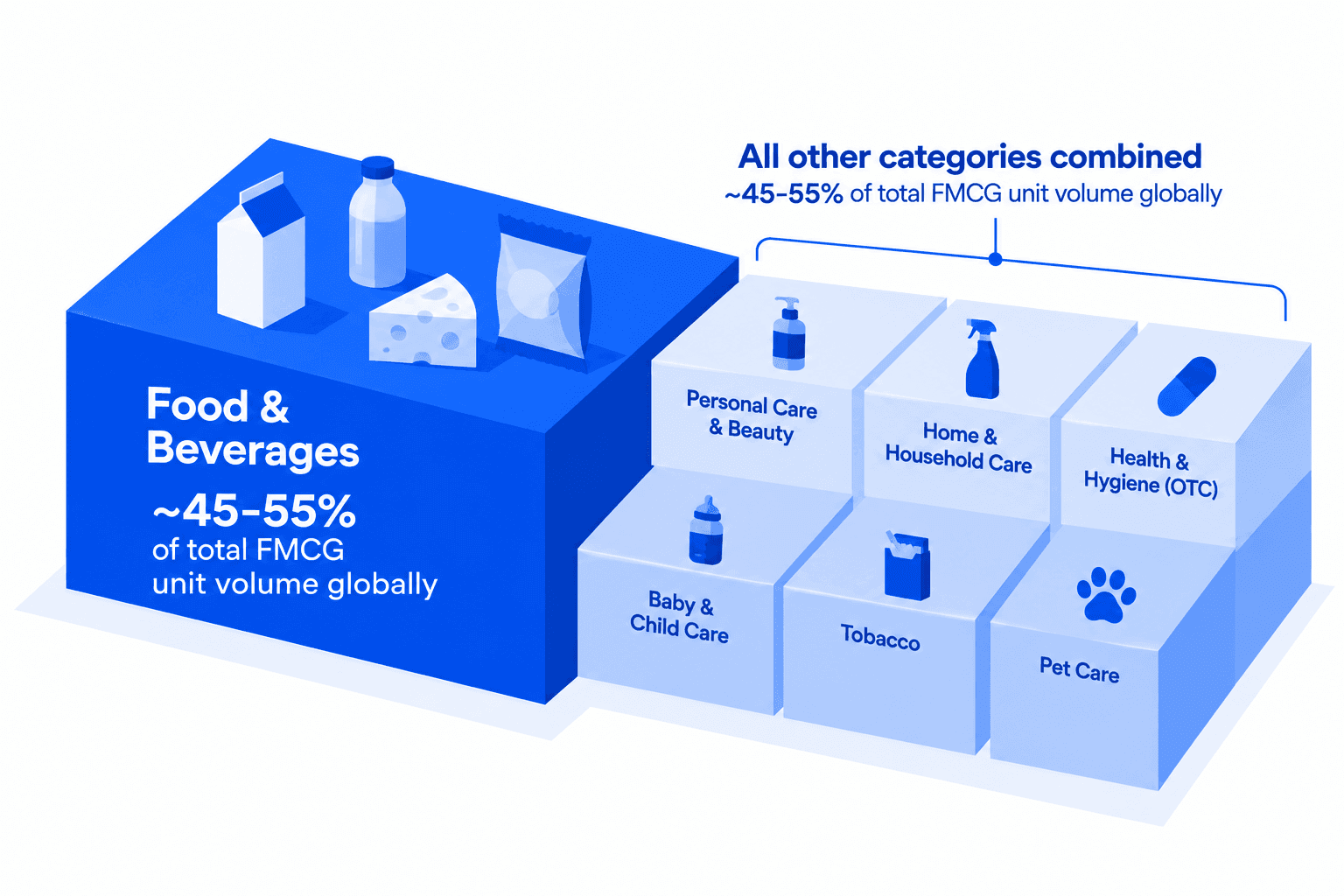
- Food and Beverages combined account for roughly 45-55% of total FMCG unit volume globally.
- The GCC is a modern-trade-dominant market, unlike many emerging markets where traditional trade still leads.
- Multinationals are investing directly in the region now (PepsiCo's new Riyadh regional HQ and R&D hub), not just distributing into it.
- Net revenue management and trade promotion management are the two operational disciplines underneath all of this, regardless of channel.
The Main Categories Within the FMCG Industry
The industry is usually broken into eight working categories:
| Category | What it includes |
|---|---|
| Food | Snack foods (chips, biscuits, chocolate), processed grocery (cereals, canned goods, sauces, frozen foods), baked goods, dairy |
| Beverages | Soft drinks, bottled water, tea and coffee (packaged or ready-to-drink), sports and energy drinks |
| Personal Care & Beauty | Toiletries, cosmetics, skincare, hair care, personal hygiene items |
| Home & Household Care | Cleaning products, detergents, air fresheners, household essentials |
| Health & Hygiene (OTC) | Over-the-counter health products and hygiene items |
| Baby & Child Care | Baby food, diapers, childcare items |
| Tobacco | Cigarettes, cigars, and tobacco-related products |
| Pet Care | Pet food and pet grooming products |
Food and Beverages combined account for the large majority of total FMCG unit volume globally, well ahead of any other category. That's why so much of the assortment optimization discipline in this industry is built around grocery and food categories specifically: it's simply where the largest share of shelf space, and the largest share of the optimization opportunity, actually sits.
How Products Reach the Shelf: Trade Channels
Traditional trade is the unorganized retail network: independent grocers, small local shops, informal outlets. It still dominates FMCG volume in many emerging markets, notably in South Asia. Modern trade is organized retail through supermarkets, hypermarkets, and chains.
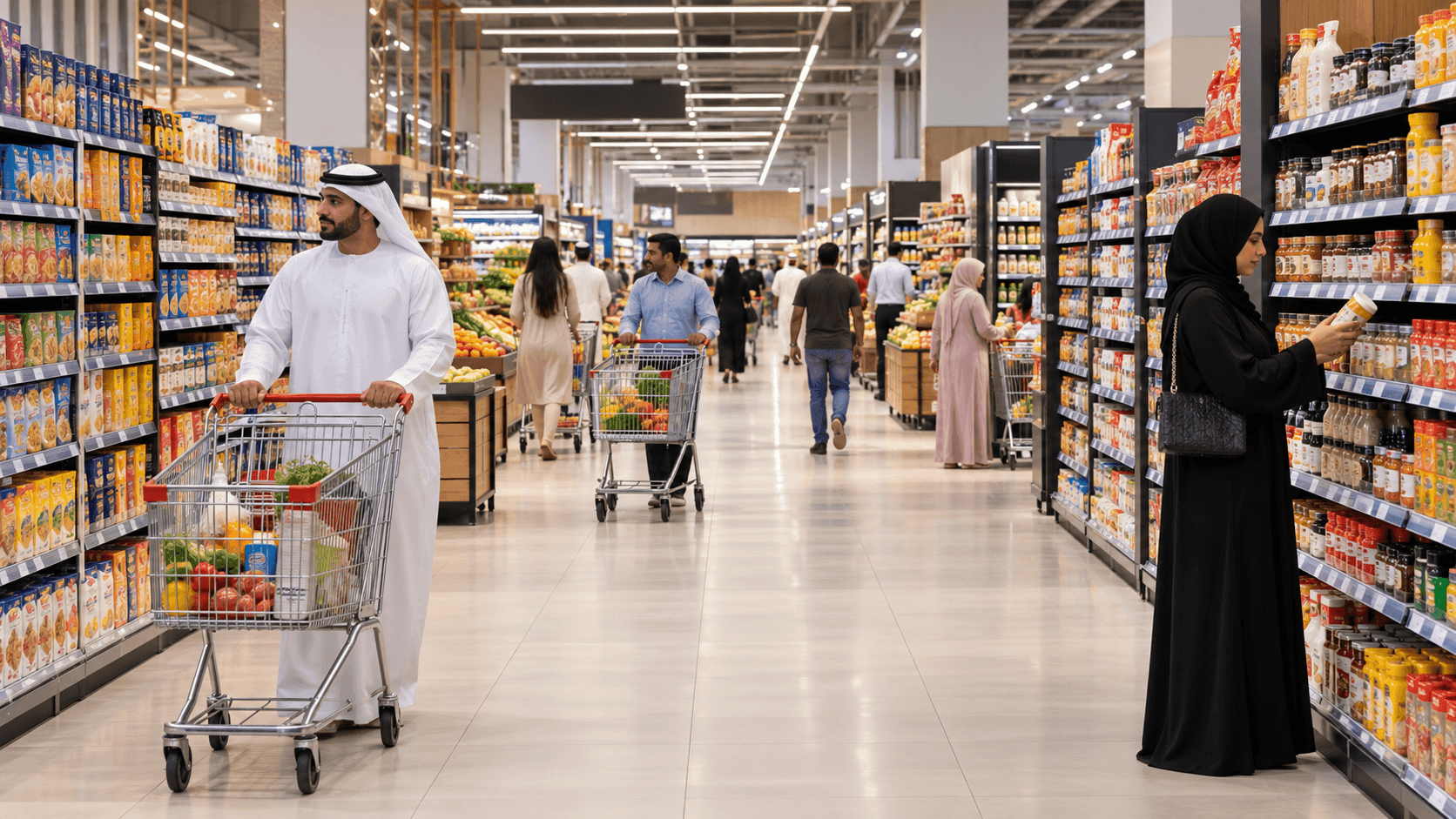
The GCC sits at the opposite end of that spectrum from those markets. UAE retail is concentrated among a defined set of modern trade players (Lulu Group, Carrefour/Majid Al Futtaim, Choithrams, Spinneys, Union Coop, Nesto, and Viva Supermarket), and modern trade, not traditional trade, is where the overwhelming majority of FMCG volume moves. That concentration is exactly why a small number of retailer relationships carry disproportionate weight in a GCC supplier's growth plan, unlike a fragmented traditional-trade market where no single relationship matters as much.
E-commerce and quick commerce are the fastest-growing channel on top of that base, adding a third, faster-moving route to the same shopper.
Two operational disciplines sit underneath all of this regardless of channel: net revenue management (getting pricing, promotion, and trade spend to work together instead of against each other) and trade promotion management (planning and tracking the promotional calendar itself). Both are shifting toward far more granular customer segmentation, moving away from one plan per channel and toward something closer to a segment of one.
Underneath both sits a third discipline that's harder to see on a channel chart: the quality of the supplier-retailer relationship carrying the plan. That's what the Advantage Report measures, scoring suppliers on Organisation & People, Trade & Shopper Marketing, Supply Chain & Customer Service, Category & Consumer Marketing, and E-commerce. In a modern-trade-dominant market like the GCC, where a handful of retailers control most of the volume, those scores tend to predict commercial outcomes better than category growth rates do.
What's Shifting in the GCC FMCG Industry Right Now
A few concrete signals of where the region is heading:
- Multinationals are investing directly in the region, not just distributing into it. PepsiCo's new Middle East regional headquarters in Riyadh, backed by a SAR 30 million R&D hub, is a signal that global players increasingly treat the GCC as a market worth building for locally, not just shipping into.
- Category growth is shifting toward health and specialty. Protein-enriched snacks, functional beverages, plant-based alternatives, organic staples, and specialty ethnic foods are gaining traction across the region.
- The rest of the GCC isn't identical to the UAE and Saudi Arabia. Qatar's post-World Cup infrastructure and high-income base, Bahrain's open trade environment and lower entry costs, and Oman's still-developing modern trade sector each carry a different entry logic, worth knowing if a supplier's ambitions extend beyond the two largest markets, which is exactly the kind of cross-market scaling We Grow is built to support.
Who Operates in Each Segment
Frequently Asked Questions
What are the main categories of the FMCG industry?
Eight working categories: Food, Beverages, Personal Care & Beauty, Home & Household Care, Health & Hygiene (OTC), Baby & Child Care, Tobacco, and Pet Care. Food and Beverages combined make up by far the largest share of unit volume.
What's the difference between traditional trade and modern trade?
Traditional trade is the unorganized retail network of independent shops and grocers. Modern trade is organized retail through supermarkets, hypermarkets, and chains. The GCC is a modern-trade-dominant market, unlike many emerging markets where traditional trade still leads.
Is the GCC FMCG market growing?
Yes. UAE retail value sales grew 7% in 2025, outperforming many other regional and global markets, and Saudi Arabia remains the GCC's largest retail market overall.
What FMCG categories are growing fastest in the GCC?
Protein-enriched snacks, functional beverages, plant-based alternatives, organic staples, and specialty ethnic foods are the categories most consistently cited as gaining traction across the region right now.
How is e-commerce changing the FMCG industry in the GCC?
It's added a third, faster-growing channel on top of the traditional/modern trade split, giving suppliers a direct route to shoppers that doesn't depend entirely on shelf space in a physical store.
The FMCG industry isn't one undifferentiated market. It's eight categories moving through different trade channels at different speeds, and in the GCC specifically, that means modern trade concentration and a shift toward direct regional investment are the two trends worth tracking closest.